

TLDR
New technologies change what we can do; hence what we can know; hence what we can trust. These transitions happen every few centuries; we’re living through one such transition today.
This impacts everything. Read on!
Introduction
5 years ago, “intelligence” was a scarce asset. Humans had a monopoly on it.
LLMs changed that. And they changed it so successfully that the scarcity migrated upstream. Training data, chips, energy: everything that went into an LLM became super valuable.
I wrote these words in May 2023, right here on Pivotal:
A possibly lucrative question to ask is, where are the new areas of scarcity? The hardware that powers computation and data is an obvious candidate. Persistent and recurring chip shortages are a symptom of this.
Another candidate for scarcity is energy. Large model training consumes a huge amount of energy. Once you add in accelerating flywheels and agents everywhere, the quantities become vast.
A pretty good prediction, yes? Chip, electricity and data prices are at all-time highs. NVIDIA was at $28 then; it’s at $228 today.
Skating To Where The Puck Is Going
But here at Pivotal World Headquarters, we prefer not to rest on our laurels. The question is not, what was scarce yesterday or even what is scarce today; the question is, what will be scarce tomorrow?
The last three years have seen staggering investments into precisely the three areas I wrote about in 2023: chips, energy, and data1. Supply of all three remains tight, but it has somehow managed to keep pace with even the most optimistic forecasts of demand. The price per unit of intelligence continues to drop.
And so the squeeze moves towards complementary assets. If intelligence is abundant and cheap, what becomes relatively scarce, and hence valuable?
That which allows you to evaluate, and use, and rely on intelligence.
The scarce asset is now trust.
Slopocalypse Now
This should not come as a surprise.
The felicity with which AI creates, propagates, and amplifies content – combined with The Algorithm’s brilliance at giving people what they want to hear, read or feel – means you can’t trust anything you see on any device.
Hallucinations and fakes abound. Slop is everywhere. A million monkeys on a million typewriters can’t outdo AI’s casual prolixity.
This would be fine (annoying af, but basically fine) if it were confined to consumer content, but AI has taken over work-product as well. AI emails, AI slide decks, AI financial models, AI research reports, AI marketing copy – the deluge is here.
And this too would be fine if the work-product were good. Some of it is very good indeed. But much of it is not.
Where did those numbers come from? How did you draw that conclusion? Who said that, and did they really say it? Often, you have no way of knowing. Trust is the scarce asset.
Caution: Rogue Robots
Slop is not the only way AI erodes trust.
Agents play fast and loose with permissions. Sometimes this is intentional: app creators tell their models to “get the job done no matter what”, to wow users and grab market share. And sometimes, this is simply what happens when you combine powerful, nascent technology, imprecise instructions, and imperfect security.2
The companies building and investing in these agents don’t exactly inspire confidence either. Firms wield immense power (political, economic, behavioural), but without the accompanying responsibility. The mad rush to build ever-better intelligence, take over every vertical, acquire generational and maybe civilizational wealth, and utterly transform society means that the tech industry’s reputation is at an all-time low.
Those Who Misunderstand History ...
This has all happened before.
Writing made long-term memory possible; there was a flood of propaganda and forgery; law codes and seals and witnesses were among the first recorded social innovations; city-states and bureaucracies emerged.
Coinage made trading with strangers possible; there was a flood of counterfeiting and clipping; royal mints and hard-money norms evolved; exchanges and trade networks emerged.
The printing press made copying cheap; there was a flood of piracy, canards and fake news; copyright, journals and citations emerged as a response; modern science and media are the result.
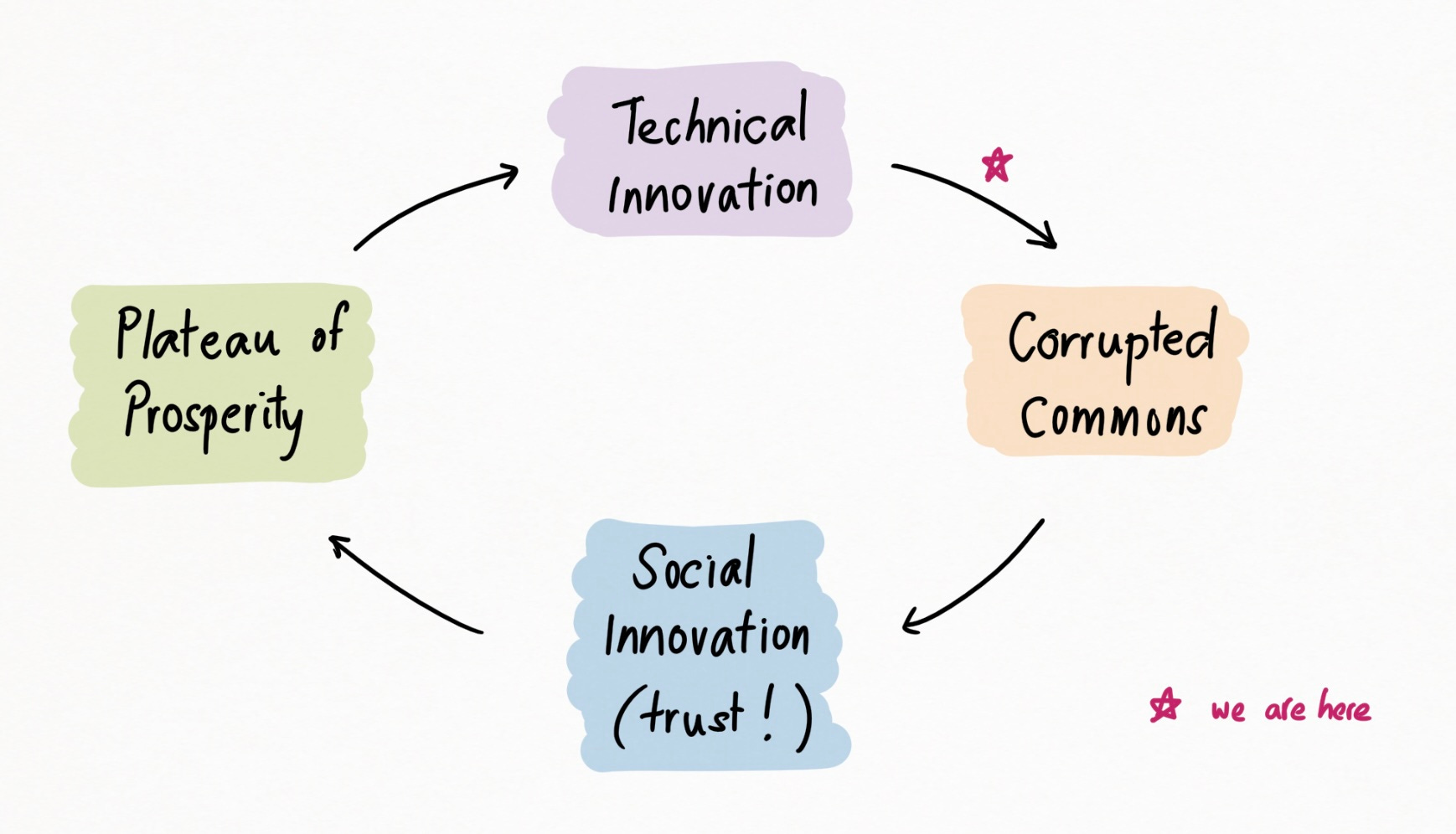
The pattern is well-established:
New “physical” technologies emerge to make a thing possible or cheap →
There’s a flood of low-quality slop and a messy transitional period →
New “social” technologies evolve to control this flood →
And society ascends to a new scale of cooperation and enablement
The story of civilization is the story of how societies evolve to solve the problem of trust. Without trust, you cannot have coordination; without coordination, you cannot have scale. The very word “civilized” carries a connotation of “you can trust them”.
We’re currently in the messy transition period between the emergence of AI as an insanely powerful production technology, and the evolution of the corresponding social protections3. This will be the problem of the next few years.
... Are Condemned To Repeat It
New technologies render old intuitions obsolete.
Polish used to be a good indicator of trust, because it required effort. And effort correlates across tasks. Why would anyone spend hours on formatting and structure, language and presentation, if they were going to skimp on the underlying analysis? Unfortunately, LLMs break this correlation: they’re great at creating beautifully polished work that happens to be utterly wrong.
Authority used to mean, literally, somebody you can trust. Ha! Not any more. In every field, the people who use AI tend to outproduce – and hence outperform – the people who don’t. Authority therefore accrues, not to the best or most “trustworthy”, but to the most prolific.4
And that’s assuming you can even tell who created what. Authenticity used to be hard to fake. But LLMs are trained to deliver human-like (and human-liked) outputs, and they’re getting ever better at it.
All of these changes are downstream of changes to Incentives, especially around “reputation in repeated games”. I trust you in any given interaction because I assume that you care about future interactions. Delivering low quality work (polished slop, unearned authority) jeopardizes those future interactions.
LLMs disturb this equilibrium. Slop is easier to create and harder to detect; ditto fakes and false authority. There’s very little enforcement, or even stigma, attached to voluminous low-trust output – in fact many systems tend to reward it. And most of all, there’s a sense that we’re in a one-off transition, where the prize on offer today is big enough to override all consideration for the future. The incentives have changed; grab that bag now!
Rekindling Trust
These intuitions are helpful, because they suggest five clear ways to rekindle trust:
1. Costly signals. Superficial polish is cheap, and hence no longer a good indicator of underlying quality. So you need new, “costly” signals as proof of trustworthiness.
2. Third-party evaluations. LLMs can’t self-certify; producers have skewed incentives; and consumers simply can’t tell the difference. So you need specialist, trusted, high-accuracy third-party sources of trust.
3. Penalties and enforcement. Flagging isn’t enough; you need enforcement.
4. Accountable humans. And you need someone to penalize! (Or claim recompense from).
5. Repeated games. Above all, you need repeated games to create reputational incentives, so that people self-select into the above behaviours.
Ladies and gentlemen, I present to you, the finance industry!
Finance Is Finicky ... And Wise
Finance is an industry built on trust. All the above structural features – costly signals, neutral ratings, self-imposed enforcement, reputation protection – exist and indeed were often invented in finance. From the honour code of the trading floor, to the sanctity of financial statements, to the pillars of audit and compliance, to the privileged access given to finance teams – finance is trust.
Finance is also the industry that has perhaps the largest gap between AI capabilities and AI adoption. This is not a coincidence. Faced with the erosion of these protections by LLMs, the industry very rationally decided not to engage. Finance avoids AI precisely because AI elides trust.
Building Trust-First Companies
But avoidance is not a permanent solution. Finance cannot stand at the water’s edge, shouting “stop!” at the AI wave. No industry can. Whoever unlocks AI in finance unlocks trillions in value.
So let’s learn from success. How have other industries – many with high trust bars of their own – handled the AI transition?
The answer is to build trust-first institutions. These are organizations where trust is not an afterthought; not one bullet on a long list of features; but rather, the core of their value prop.
OpenEvidence, with its AI for doctors, is perhaps my favourite example. The value prop is right there in the name: it doesn’t just offer information, it offers evidence, with transparent citations, reputation-enhancing partnerships (NEJM, Nature, JAMA, ACC, ADA), and third-party evaluation (USMLE). Doctors use it because they trust it.
Harvey and Legora, currently engaged in a cutthroat battle for legal-AI supremacy, both attack trust head-on.
Harvey’s “Vault” guaranteed client confidentiality; they built their own BigLaw benchmark and measured their performance against it; and they started with a single highly-reputable customer (Allen & Overy).
Legora’s Europe-first strategy helped with GDPR and data sovereignty; their “diligence grid” UX made verification transparent and also fit into existing client workflows; and they too started with a referenceable mega client (Mannheimer).
It’s not about who has the data and intelligence; it’s about whose data and intelligence you trust. Source-of-trust is the new source-of-truth.

Vertical AI is not the only way to build trust-first institutions. The Artificial Intelligence Underwriting Company combines standards, audit and insurance for frontier model performance (accountability). Intercom and Sierra offer variations on “satisfaction or your money back” (costly signals). A variety of horizontal verification startups have also emerged, taking a variety of approaches (determinism, watermarks, heuristics, guardrails, benchmarks) to solve trust.5
These approaches are still early. Many industries don’t (yet) have clear AI leadership, or trust-first companies; it remains to be seen who will win. Financial AI is an especially good example of this; the field is wide open. That’s what makes life so interesting! But the problem is here, and the problem is now.
Trust is the scarce asset; act accordingly.
Toronto, October 2026
Further Reading
It may take a while for truly “trust-first” companies to emerge, especially in finance. But that shouldn’t stop individual finance professionals from using AI! How should operators and executives adjust their workflows in a world where trust is scarce?
I wrote a whole essay about this: Looks, Brains and Money. My advice:
Maintain closer control of fewer but better data inputs
Interrogate your data outputs; verify, then trust
Watch for AI pathologies, especially “careless in, convincing out”
Avoid data contamination and protect your sources of truth
Track data quality at artifact, fitness-for-purpose and business-outcome levels
The prediction of scarcity in chips and energy came from my 2023 essay Data in the Age of AI. Other predictions from that essay:
The sudden jump in the value of data for AI
The Jevons effect for AI in software (one of the first detailed write-ups)
LLMs as first-class users of the web: “agents everywhere”
The rearrangement of trust hierarchies
And finally: if you’re a finance professional – if you work in financial services, or in the finance function for some other industry – you might want to read about what I’m doing at Windkey, and join the waitlist!
Never miss a post!
Pivotal is a free newsletter of long-form essays on finance, AI, data, startups and tech. It’s written by Abraham Thomas, the founder of Windkey. I write infrequently and in depth; I like to think my pieces are worth writing, and worth reading.
Subscribe to Pivotal and share it with your friends and colleagues: especially those who work in Wall Street and Main Street finance. Encourage what you want to see more of in the world.
Hyper-scaler capex has grown >70% per year since 2023, from a baseline already measured in the 100s of billions. Multiple decacorns have been minted in pursuit of training data. TSMC’s chip packaging capacity is up 10-fold. US energy is seeing record buildouts (turbines, solar, batteries). The AI data centre boom continues apace, politics notwithstanding.
AI researchers call this “misalignment” – the gap between what users want a system to do, and what the system actually does. In finance we recognize this as a classic “principal-agent” problem.
The recent OpenAI x HuggingFace incident is a perfect example. In brief: to score highly on a benchmark, swarms of agents coordinated to hack the evaluation server. Humans only found out by accident.
Trust has been eroding for a while. Information moved from physical to digital; the internet made distribution cheap; the smartphone made access cheap; and AI made production cheap. And with information comes disinformation.
You can see this in the aggregate statistics. The public has lost trust in government, big business, science, experts and the media – all of whose presence in daily life is essentially online. Meanwhile there’s more emphasis on family and ethnic ties, rising nationalism and tribal polarization, and a resurgence of religion – the older, offline world.
Algorithmic authority is the clearest example of this. If you want to build an audience online, the first order of business is to just post a lot. Consistency trumps inspiration.
Notice how so many of these analogize to solutions from the financial world. There are now originators, standards bodies, ratings agencies, auditors, underwriters, and guarantors for trustable AI output. I wouldn’t be surprised to see more innovations along these lines: trust exchanges, trust arbitrageurs, diversified trust portfolios, derivatives on trust - indeed, an entire trust economy. If you can trade tokens, energy and data, why not trade trust? Trust as a financial asset: perhaps a topic for another Pivotal essay!
Love the article. Old methods of verification, and old incentives you could rely on, no longer function when intelligence is available and cheap. What are the new methods of verification, and new incentive structures?
A critical question seems to be: do you have to use humans as a chokepoint to produce trust (eg via accountability), or will there be something that works without running through humans at all?
You've had a report land that looked flawless and still opened the spreadsheet to check one number yourself. That instinct is the whole argument here, and it's a good one. I'd add one line to anything AI helped your team produce: who checked it, and against what. It takes a moment, and it gives the reader a person to trust instead of a polish to admire.